

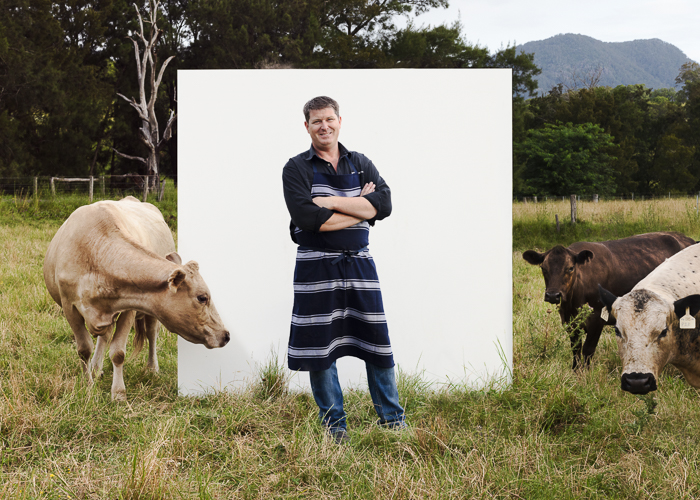
Few claims resonate with customers quite like "paddock to plate". It speaks to provenance, trust and a direct connection between producer and consumer. At Roberts Meats, it's not just a slogan. It's a philosophy that has shaped the business for more than three decades.
Robert Constable has run Robert’s Meats in Singleton NSW for 23 years and has been butchering for almost 35. He grew up on a farm, and for more than two decades the shop has been vertically integrated. The family breeds and fattens its own Speckle Park cattle, and when Robert’s property can’t supply, his father’s does. He believes what gives the paddock-to-plate phrase real meaning is traceability.
“It’s really difficult to say you’re truly paddock to plate unless you have traceability of that animal the whole way, at least from the time you started feeding it,” Robert says. “After all, everybody of beef that comes into the shop comes from a paddock somewhere, and it all goes to a plate somewhere.”
Drought and seasonal conditions can interrupt even the best supply arrangements, and most shops top up with carton meat. Robert manages this at the ticket.
“If the ticket says it’s our beef, it’s our beef. The day it’s not, we take the ticket away and replace it with one that does not say anything.”
That discipline gets harder as a business grows. In regional towns, where customers often know the farms, the paddock-to-plate story tends to hold up on its own. Across a group of city stores, it’s harder to sustain. For larger operations, the story can be built on a small group of trusted suppliers. Branded producers can carry the story too. Customers repeatedly ask Robert for Cowra lamb, thanks to years of promotion by Breakout River, his only lamb supplier for 20 years. Whatever the scale, there are opportunities to tell your customers the story of where that product came from.
From the paddock to the eating experience
In Robert’s case, customers are more interested in eating quality than origin. The question he hears most is whether the beef is grass fed, however they also want a well-marbled scotch fillet. Thirty-five years ago, leaner European breeds and low-fat health messaging favoured a big, bulging eye muscle. Today, customers expect intramuscular fat, and Robert’s cattle are finished in the paddock on a brewer’s pellet to deliver it.
In Australia, the way beef is described and marketed is subject to food labelling and consumer laws, meaning claims such as "grass fed" or "grain fed" must be accurate and able to be substantiated. While there is no legislated national definition of "grass fed", production claims must not be misleading under Australian consumer law. Grass-fed cattle are typically raised on pasture-based diets, while grain-fed cattle are finished on grain rations for a defined period. Importantly, terms such as grass fed and grain fed describe how the animal was fed, not necessarily the tenderness, flavour or eating quality of the beef, which are influenced by a range of factors including genetics, nutrition, marbling and processing
“All I’ve seen in the last 35 years is beef and lamb get better and better,” he says.
“Knowing how an animal was bred and finished lets you explain why it eats well, and that’s the connection customers respond to.” He says rump is a good example. Once a cut butchers had to work to keep moving, it’s now Robert’s top-selling steak, with customers seeing it as a quality eating experience at around $40 a kilo.
Know your story
Robert’s advice is to know what you’re talking about, do your research, “hook up with really good people for a start, and follow it through”.
“If you can say, ‘Brian supplies me. You know Brian? He’s five Ks out this road. He’s our farmer,’ then you’ve got a story,” he says.
Robert believes most producers would welcome a direct relationship with a butcher, and that it’s worth building. Build those relationships and know your product well enough to explain it over the counter, and paddock to plate becomes a story customers can trust.