

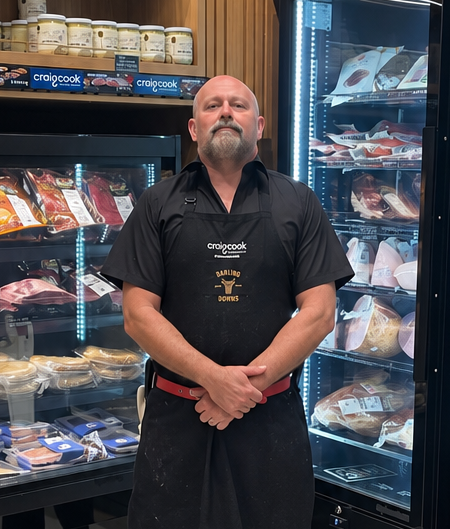
If your shop sits in a shopping centre, the supermarket is probably both your biggest competitor and your biggest source of customers. Michael Honeysett, general manager of Craig Cook’s Prime Quality Meats, has spent three decades learning how to make that relationship work in his favour.
With 12 stores, including a new site at Castle Towers in Castle Hill, Sydney, Michael is clear about what gives independent butchers the edge.
The first is a hands-on approach to product selection and sourcing. Craig Cook’s runs its own farm in the Southern Highlands, producing grass-fed Angus cross cattle raised without HGPs (hormonal growth promotants). Product from other suppliers is checked on arrival, and if a carton of scotch fillet, for example, doesn’t meet spec, it goes straight back.
“Each and every piece of meat that comes into our stores is hand-selected,” he says. “That kind of hands-on selection is very hard to replicate when you’re buying tens of thousands of head at a time.”
The second is the breadth of trade skills behind the counter. A qualified butcher understands the whole animal, from breaking a body of beef to making a sausage, and that knowledge lets a small business move quickly.
“We can create something this morning and have it in the window selling by this afternoon,” Michael says. In contrast, a large supermarket corporation can take months to develop, test and roll out a new line.
The third is conversation.
“Every customer that comes in is trying to answer the same question: what’s for dinner tonight?” Michael says.
A butcher who tried a new rub on lamb cutlets at home last night can recommend it with genuine enthusiasm, which is the kind of personal advice customers can’t find on a supermarket shelf.
Making the supermarket work for you
Despite being competitors for a customer’s red meat budget, supermarkets play an important role in the health of the independent butchery sector, especially for butchers whose stores are located in shopping centres.
Michael is clear about the benefits that the supermarkets bring.
“Without them, we don’t survive,” he says. “In a shopping centre, the rent is astronomical because you’ve got so much foot traffic; without the supermarkets, you don’t have that foot traffic.”
He also gives them credit for lifting the standard of red meat on their shelves.
“Twenty years ago, you couldn’t go to a supermarket and get a really good quality piece of steak; now you can. That’s why butchers need to keep creating to stay ahead.”
Michael says supermarkets’ processing lines are staffed by specialists who are fast and precise at a single task, and their scale delivers the consistency and convenience shoppers rely on for the weekly shop.
To catch those shoppers on their way past, Craig Cook’s relies on cooking demonstrations out the front of most stores and staff who greet people as they walk by.
“Sometimes that’s all it takes,” he says.
Because supermarket quality keeps improving, Michael believes independents need to keep evolving. New sausage flavours, fresh rubs and seasonings on familiar cuts, and value-added lines made on the premises. Craig Cook’s newer stores now include burger and pie counters using its own product.
Above all, get customers tasting your product, and give them a reason to try something different from what they’re cooking regularly.
“If we’ve got something new, we can always stay ahead of the curve.”